
What Is a Digital Sales Room?
A digital sales room (DSR) is a private, branded online workspace where B2B sellers and buyers collaborate on a single deal. Content, timelines, stakeholders, and communication live in one link instead of scattered across email threads and attachments.
Why B2B Teams Need a Digital Sales Room in 2026
Buying behavior has moved past the point where a shared folder or a string of emails can keep a deal organized.
Research from 6sense has found that a large majority of B2B buyers already have their purchase requirements worked out before they ever speak to a sales rep.
Gartner has reported that sellers get roughly 17% of a buying team’s total time during a deal; the rest happens without a rep in the room, through internal discussion and independent content review.
Deals have also gotten more crowded. The average B2B buying group now runs 9 to 11 individuals, each with different priorities, questions, and levels of context. A DSR gives sellers a structured presence during the part of the cycle they aren’t directly part of, and gives buying committees a shared reference point instead of a dozen separate email threads.
Why Traditional Methods Don’t Work Anymore
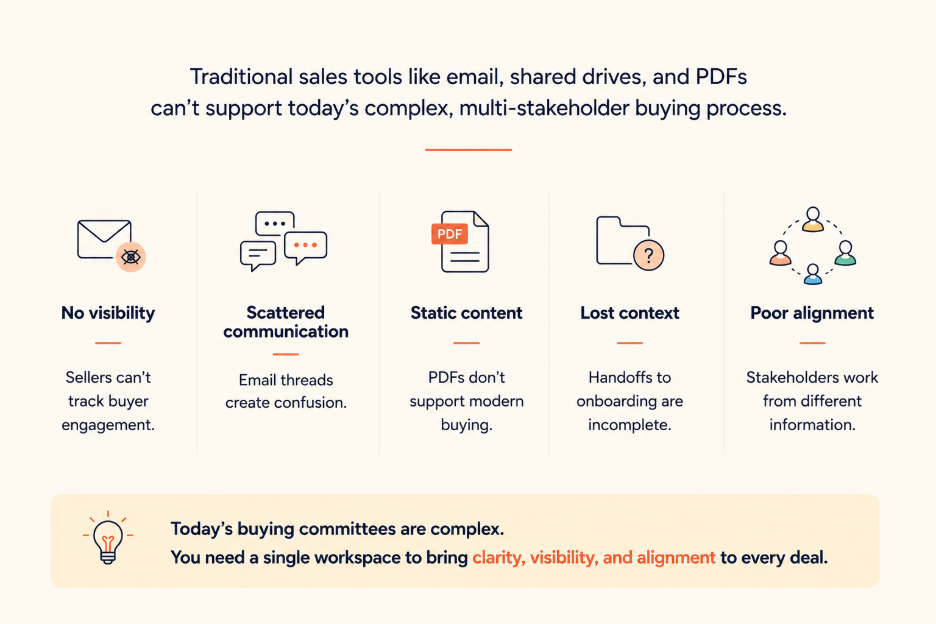
- No visibility into buyer engagement: Once a file is emailed, sales teams can’t see who viewed it, what they engaged with, or whether it reached key decision-makers.
- Scattered communication: Multiple email threads and shared links create confusion and make it easy for stakeholders to reference outdated pricing, proposals, or documents.
- Poor self-serve experience: Static PDFs and presentations don’t support the independent research that buying committees do between meetings.
- Knowledge gets lost: Email conversations and attachments don’t transfer smoothly to onboarding or customer success, forcing teams to recreate context.
- Difficult stakeholder alignment: With buying committees often involving nine or more people, traditional methods can’t keep everyone working from the same, up-to-date information.
Benefits of Using a Digital Sales Room
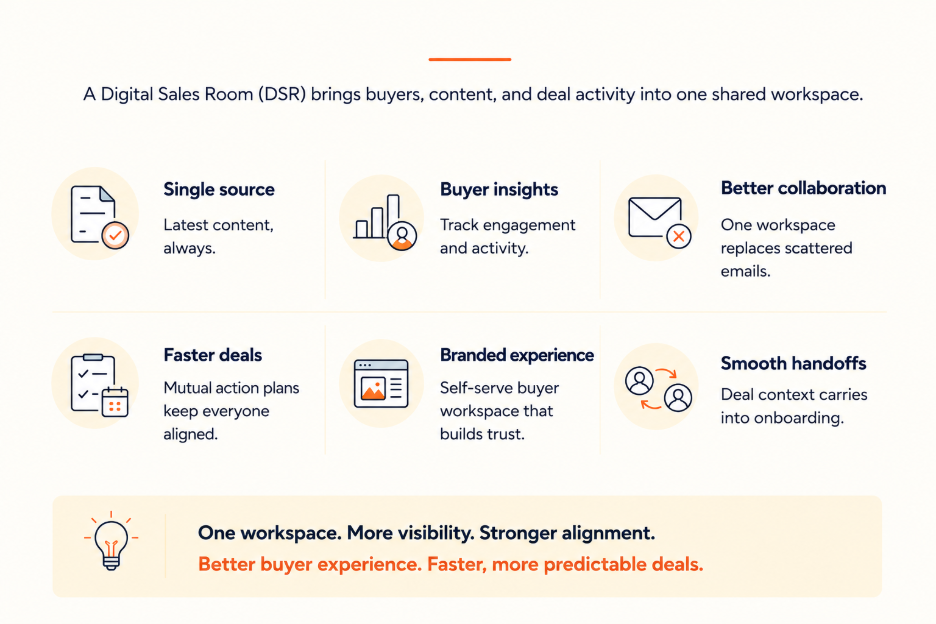
- Centralized content: Keep all sales assets in one place, with buyers always seeing the latest version.
- Buyer engagement insights: Track who viewed content, what they engaged with, and key stakeholders involved.
- Shared workspace: Replace scattered emails and file links with a single collaborative deal space.
- Mutual action plans: Keep buyers and sellers aligned on timelines, tasks, and next steps.
- Branded buyer experience: Provide a professional, self-serve workspace that builds trust.
- Seamless onboarding: Carry deal context into customer success for smoother handoffs.
- Supports self-serve buying: Let buyers access information independently throughout the buying journey.
Digital Sales Room Trends Shaping 2026
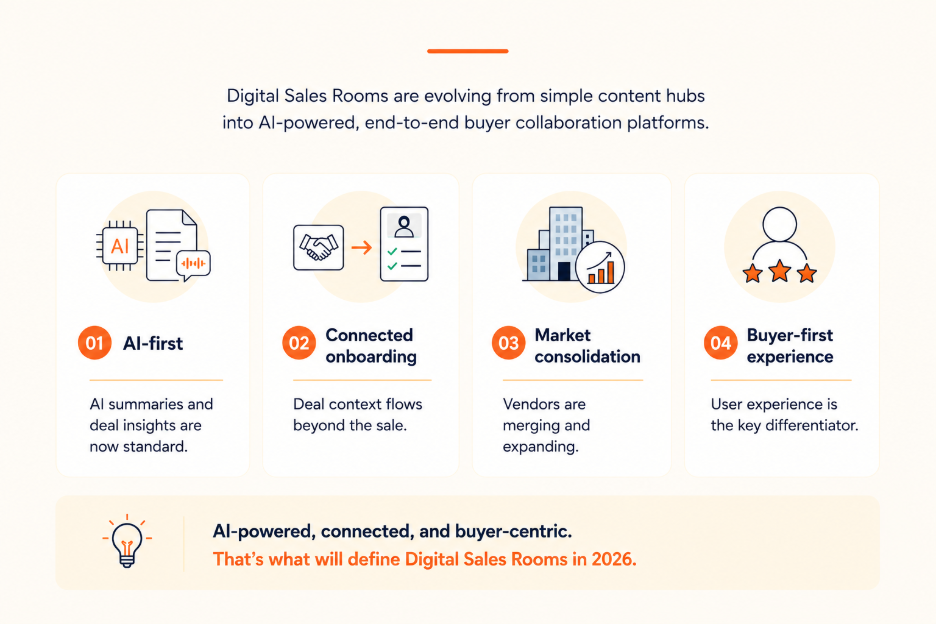
- AI-native deal capture, including automatic transcription, meeting summaries, and deal intelligence, is becoming a baseline expectation rather than a premium add-on.
- Onboarding continuity is turning into a real differentiator. Platforms that stop at signature are losing ground to ones that carry the deal record into onboarding and adoption tracking.
- The vendor landscape is consolidating. Several large sales enablement platforms with DSR features moved toward mergers and private equity ownership over the past year, reshaping pricing and product roadmaps at the top of the market.
- As feature sets converge across vendors, the buyer-facing experience itself is becoming the main point of competition, not just what sellers can do behind the scenes.
The Top 7 Digital Sales Room Platforms
1. Trumpet
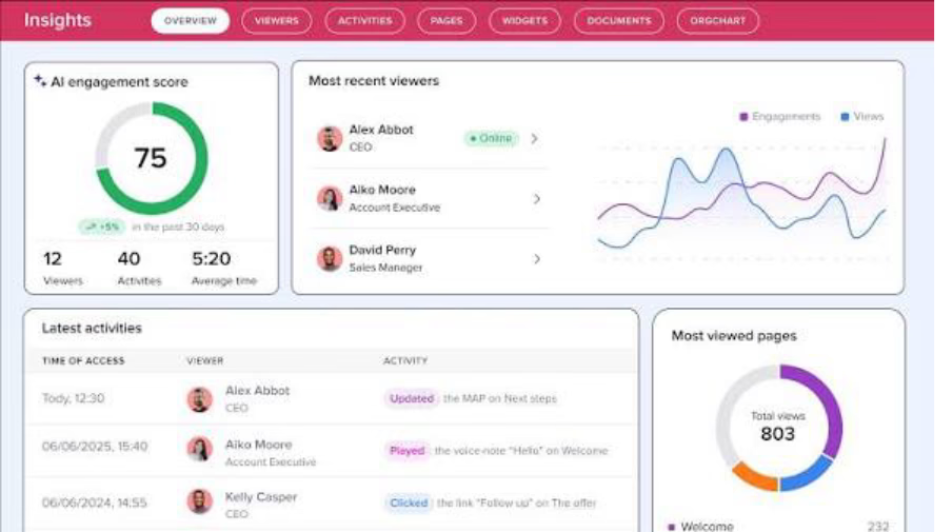
Trumpet’s Pods are fully customizable, letting teams tailor navigation, branding, fonts, and content. It integrates bidirectionally with Salesforce and HubSpot, while its AI tracks stakeholder engagement, identifies at-risk deals, automatically brands rooms, and generates executive summaries from call transcripts.
Best for: Teams that want the broadest all-in-one workspace: deal rooms, mutual action plans, e-signature, and CS handoff in one platform.
Features
- Branded, interactive “Pods” combining content, video, mutual action plans, proposals, and e-signature
- AI-powered content recommendations and deal intelligence
- Real-time engagement tracking (who viewed what, when)
- Sales-to-onboarding continuity within the same workspace
Limitations
- Free plan caps at 10 Pods per account; deeper integrations only unlock on higher tiers
- Reviewers report occasional glitchiness and limited Zapier/Make automation
- Setup and customization can be time-consuming despite the polished front end
Verified G2 Rating: 4.7/5
Pricing: Trumpet uses tiered per-user pricing: Free (10 sales rooms, unlimited users), Pro $45/user/month, Scale $100/user/month, and Elite $160/user/month (sales-assisted). Annual billing shown is $450/$1,000/$1,600 per user/year respectively.
2. Dock
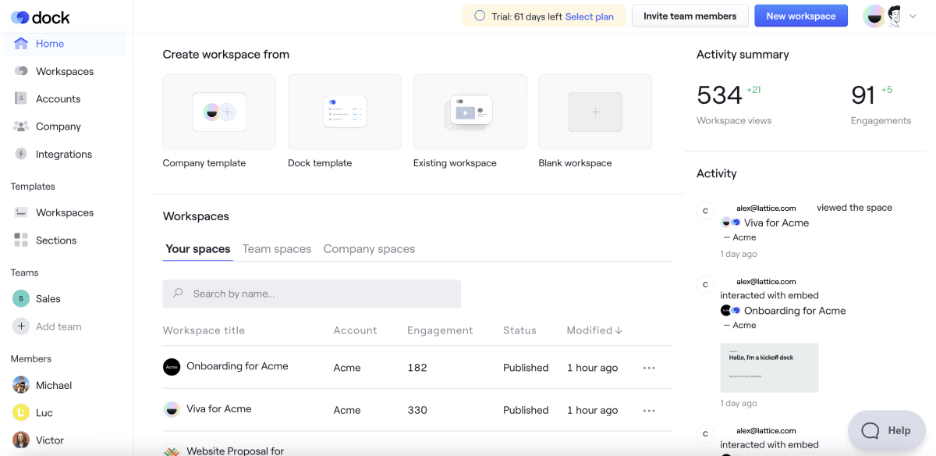
Dock extends the sales room into onboarding through a single shared workspace, helping teams maintain continuity after the deal closes. It integrates natively with Salesforce and HubSpot and supports proposals and video content. However, its CPQ and commerce capabilities are limited, and its AI features are still in beta, with a primary focus on internal sales workflows.
Best for: Teams that want strong post-sale and onboarding continuity, particularly CS teams managing renewals and expansion.
Features
- Digital sales rooms plus dedicated customer onboarding hubs
- AI enablement agent that answers rep questions using company content, CRM data, and call transcripts
- Content management and learning tools spanning the full customer lifecycle
- Personalized client portals with strong analytics
Limitations
- Deeper CRM sync and advanced features require the Premium tier
- Smaller review base and enterprise track record than Trumpet, Aligned, or GetAccept
- Less suited to CPQ-heavy or complex quoting workflows
Verified G2 Rating: 4.6/5
Pricing: Dock uses flat platform fees, not per-seat pricing: Free ($0 forever), Standard ($350/month), and Premium ($1,000/month, billed annually). Enterprise is custom, via annual contract.
3. Projetly
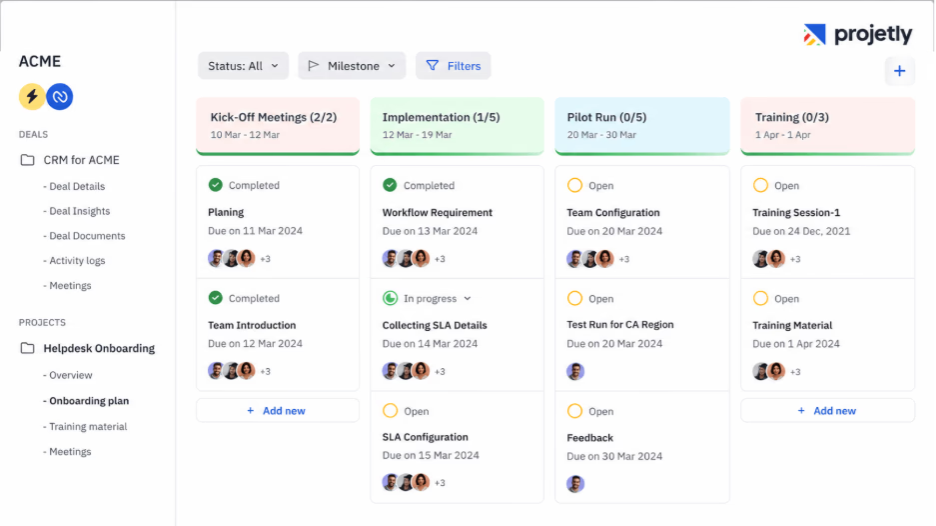
Projetly is an AI-native digital sales room built for enterprise B2B sales. Unlike most competitors, the same deal room seamlessly transitions into customer onboarding, preserving context from the sales cycle through implementation.
Best for: Teams running complex, multi-stakeholder enterprise deals who want the sales room to carry forward into onboarding and adoption tracking without a separate handoff.
Features
- AI-native deal room built for enterprise B2B sales cycles, typically three to nine months with five or more stakeholders
- Automatic capture of deal insights from customer conversations
- Stakeholder mapping and org charts for buying committees
- Automatic conversion of Closed Won deals into structured onboarding projects
- Post-sale adoption monitoring with engagement nudges
Limitations
- No integrated video coaching, skill development, or standalone learning management system
- Narrower multilingual content support than more established platforms
Verified G2 Rating: 4.8/5
Pricing: Plans start at $19/month (Starter) for onboarding teams, $49/month (Growth) with AI-powered digital sales rooms and advanced automation, and $99/month (Enterprise) for enterprise GTM teams with expanded capabilities.
4. Aligned
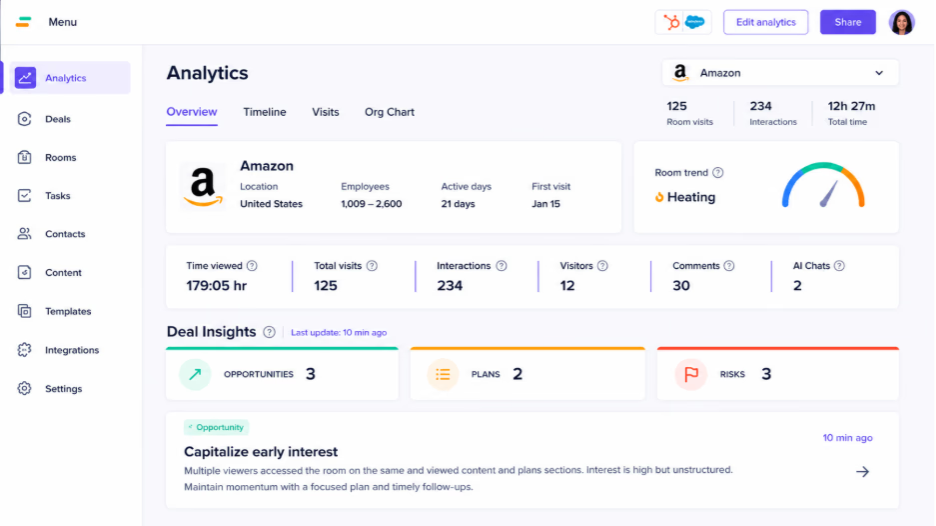
Aligned is designed for buyer-centric, interactive deal management rather than static content sharing. Its AI generates deal rooms, proposals, and next-step recommendations, while collaboration features like contextual comments, tagging, granular permissions, and bidirectional Salesforce and HubSpot integrations keep buyers and sellers aligned.
Best for: Mid-market teams that prioritize the buyer-facing experience and want to go live fast, without heavy RevOps involvement.
Features
- Buyer-facing collaboration workspace combining stakeholders, documents, and tasks
- Embedded AI Copilot for real-time deal insights
- Prescriptive, easy-to-adopt UI that keeps reps consistent
- Functions as both a Digital Sales Room and client portal
Limitations
- More prescriptive and templated than fully customizable, which limits flexibility for teams wanting bespoke room design
- Lighter on enterprise-grade governance and complex CPQ or contract workflows than DealHub or GetAccept
- Best suited to small-to-mid team deployments rather than large, highly regulated enterprises
Verified G2 Rating: 4.7/5
Pricing: Aligned offers a Free Starter plan, with paid plans starting at $35/user/month (Basic) and $60/user/month (Pro). Enterprise pricing is custom, with advanced AI, CRM integrations, and security features.
5. GetAccept
GetAccept combines no-code digital sales room templates, e-signatures, live in-document chat, and video messaging with bidirectional CRM integrations across Salesforce, HubSpot, Microsoft Dynamics, Pipedrive, and Upsales. Its AI personalizes sales content and analyzes meeting transcripts to help teams move deals forward.
Best for: Teams that want e-signature, proposals, and deal rooms consolidated into a single tool rather than separate point solutions.
Features
- Deal Room (first meeting through proposal) and Contract Room (proposal through signed deal) in one flow
- Native e-signature and contract workflows
- AI-driven sales personalization
- One of the more established players in the category, founded 2015
Limitations
- Reviewers note setup can feel complex for some teams
- Requests for deeper white-labeling on send-outs are a recurring theme in feedback
- Lighter on customer onboarding and CS tooling compared to Dock or Projetly
Verified G2 Rating: 4.6/5
Pricing: The entry-level eSign plan starts at $25 per user per month, with the Professional tier priced at $49 per user per month (minimum five users, billed annually). Enterprise pricing is custom.
6. DealHub
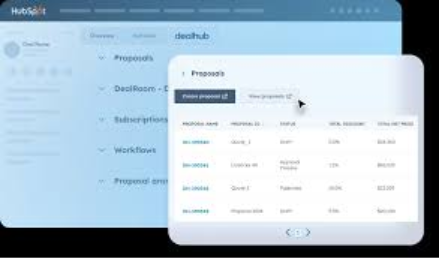
DealHub combines Digital Sales Rooms, CPQ, contract management, and e-signatures in a single revenue platform. Its AI-powered platform helps sales teams create personalized buyer experiences, automate quoting, and accelerate deal execution.
Best for: Sales orgs where CPQ complexity, such as configurable pricing, approvals, and contract variants, is the main obstacle, not just content or collaboration.
Features
- Full Configuration, Pricing, Quote (CPQ) engine built into the deal room
- Contract Lifecycle Management (CLM) and subscription/billing workflows
- Native integration within Salesforce and Microsoft Dynamics CRM
- Consolidates what many teams run as 3 to 5 separate tools into one workflow
Limitations
- Lighter on broader sales enablement and rep training or coaching features
- Custom, contact-us pricing makes upfront cost comparison harder than with competitors that publish tiers
- Narrower fit overall; teams without complex quoting needs may find it more platform than they need
Verified G2 Rating: 4.7/5
Pricing: Custom quote only, not publicly published. Contact DealHub directly.
7. Highspot
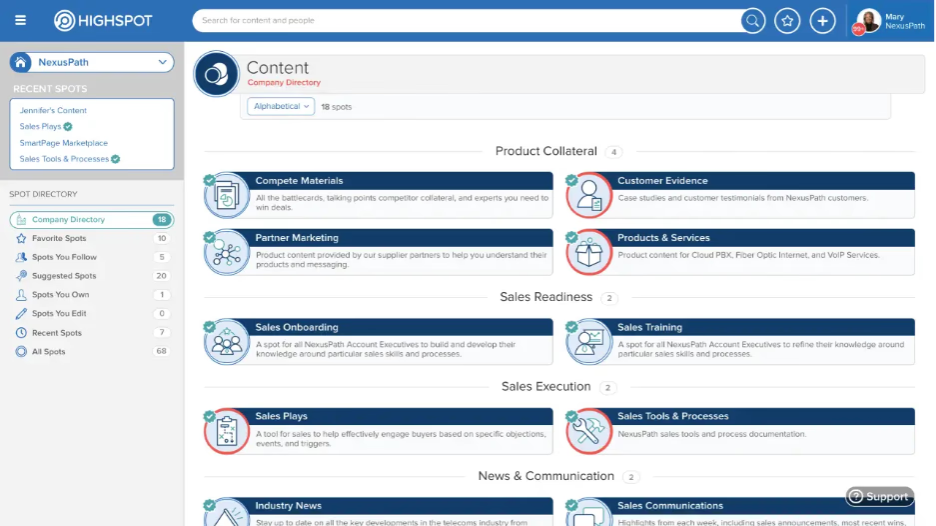
Highspot’s Digital Sales Room is part of its broader revenue enablement platform, enabling reps to create branded buyer rooms from Outlook, Gmail, CRM, or Highspot. AI can automatically generate rooms from content, while features like content watermarking, locked templates, and support for 26 languages help maintain brand consistency.
Best for: Large enterprises already standardized on Salesforce that want content governance and the deal room under one platform.
Features
- Deep, native Salesforce integration; reps can share rooms directly from Salesforce
- Buyer engagement automatically maps back to CRM records
- Strong content governance and management for large, distributed sales orgs
- Enterprise-grade security and permissioning
Limitations
- The DSR module functions as an addition to a content-first platform rather than a native, unified system
- Less buyer-facing polish compared to Trumpet or Aligned
- Best value is concentrated in Salesforce-heavy environments; less compelling for teams on other CRMs
- Highspot and Seismic, the two largest sales enablement platforms with DSR features, announced a merger in February 2026 under private equity ownership, which may affect product direction and pricing going forward
Verified G2 Rating: 4.7/5
Pricing: Per-user/month platform licensing; DSR not sold standalone.
Quick Comparison
| Platform | Best For | AI | Onboarding | CRM | G2 | Pricing |
| Trumpet | All-in-one deal rooms | Deal insights, AI summaries | Yes | Salesforce, HubSpot | 4.7/5 | From ~$45/user/mo |
| Dock | Customer success teams | AI assistant (beta) | Strong | Salesforce, HubSpot | 4.6/5 | From $350/mo |
| Projetly | Enterprise sales & onboarding | AI deal insights, onboarding | Native | Salesforce, HubSpot | 4.8/5 | From $19/mo |
| Aligned | Buyer collaboration | AI rooms, proposals | Limited | Salesforce, HubSpot | 4.7/5 | From $35/user/mo |
| GetAccept | Proposals & e-signatures | AI personalization | Limited | Multiple CRMs | 4.6/5 | From £20/user/mo |
| DealHub | CPQ & contracts | AI quoting | No | Salesforce, Dynamics | 4.7/5 | Custom |
| Highspot | Sales enablement | AI content & rooms | No | Salesforce | 4.7/5 | Custom |
All figures should be reconfirmed against live G2 pages and vendor pricing pages. This category updates frequently, and several ratings above were not consistently reported across sources
Frequently Asked Questions
- Is a digital sales room the same thing as a data room?
No. A data room is typically a secure file repository used for due diligence, such as in M&A. A digital sales room is an interactive workspace used throughout an active sales cycle, and in some cases extends into onboarding.
- Do these platforms replace CRM?
No. A DSR sits on top of the CRM rather than replacing it. Activity in the room, such as a stakeholder viewing a proposal, should sync back to CRM records rather than living separately from them.
- Which platform is easiest to set up without RevOps support?
Aligned and Trumpet are built for faster, more templated rollouts. Platforms like DealHub and Highspot generally require more configuration before the first room goes live, given their CPQ and enterprise governance depth.
- Which platforms carry the deal into onboarding automatically?
Dock and Projetly are both built around this handoff. DealHub, GetAccept, and Highspot are more focused on the pre-signature sales motion and don’t automate this transition.
- How much does a digital sales room typically cost?
Pricing varies widely by platform and tier, from roughly $20 to $100 per user per month for self-serve plans, up to custom enterprise pricing for CPQ-heavy or governance-heavy platforms like DealHub and Highspot. Confirm current pricing directly with each vendor, since tiers and features change often.
- Do smaller deals need a digital sales room?
Not always. The value is clearest on complex deals with multiple stakeholders and a longer cycle. A single-stakeholder, short-cycle deal may not need the full structure a DSR provides.
Bottom Line
The right platform depends on where the deal actually gets stuck and what needs to happen after signature. Teams that want broad content, coaching, and enablement tools in one place should look at Trumpet or Highspot. Teams where CPQ complexity, like configurable pricing or contract variants, is the main obstacle will get more out of DealHub.
Teams that want e-signature and proposals consolidated into one flow should look at GetAccept, and teams that want a fast, buyer-friendly rollout without heavy setup should look at Aligned.
For teams where sales-to-onboarding continuity is the priority, Dock and Projetly are both built around that handoff. Projetly’s feature set is the most built out for this specific use case.

